Stars are noisy
Starspots rotate in and out of view, the star’s surface granulates, and PDC leaves small drifts behind. These changes are often 10–100 times deeper than a small planet’s transit, but they are slow: hours to days, where a transit lasts one to a few hours. Detrending uses that difference in timescale. It estimates a smooth trend \(T(t)\) and divides it out:
\[\tilde f(t) = \frac{f(t)}{T(t)}\]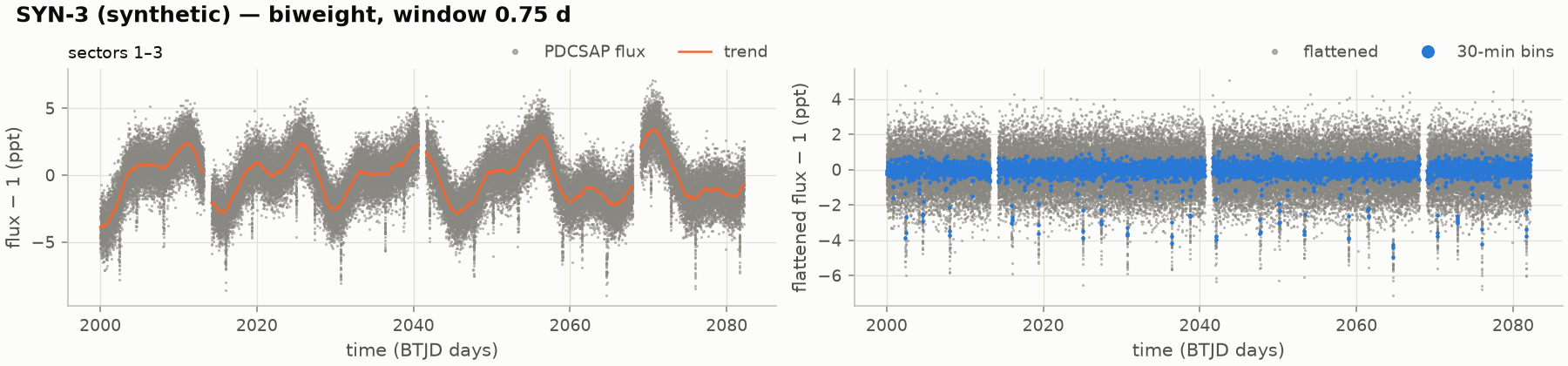
The biweight filter
The trend is a time-windowed Tukey biweight (Hippke et al. 2019, wotan). For each point,
it looks at all data within half a window (0.75 days by default) and computes a robust
“typical value” \(T\) that satisfies
It is solved by iteration, with c = 5. Points far from the local level get weight zero.
That weight function is why the biweight suits transit searches. A plain running mean treats every point equally, so it sags into each transit and erases part of it. The biweight treats the few in-transit points in each window as outliers and gives them little or no weight. In the comparison by Hippke et al. (2019) of many detrending methods, the biweight was the most reliable for transit searches.
The light curve is split wherever there is a gap longer than half a day (for example the mid-sector data downlink), and each segment is detrended separately so that the trend never has to bridge a jump.
How much of the transit survives?
A windowed filter cannot tell a transit from a starspot if the transit fills a large part of the window. For a shallow transit that is not down-weighted, the trend dips by roughly
\[\Delta T \approx \delta \times \frac{T_{14}}{W}\]where \(\delta\) is the depth, \(T_{14}\) the duration and \(W\) the window. The pipeline therefore detrends twice:
- Without a mask, for the first search pass, when nothing is known yet.
- With every detected transit masked (a window two durations wide) for fitting and vetting. Masked points are left out of the window estimates, so the trend under a transit comes from the out-of-transit data on either side.
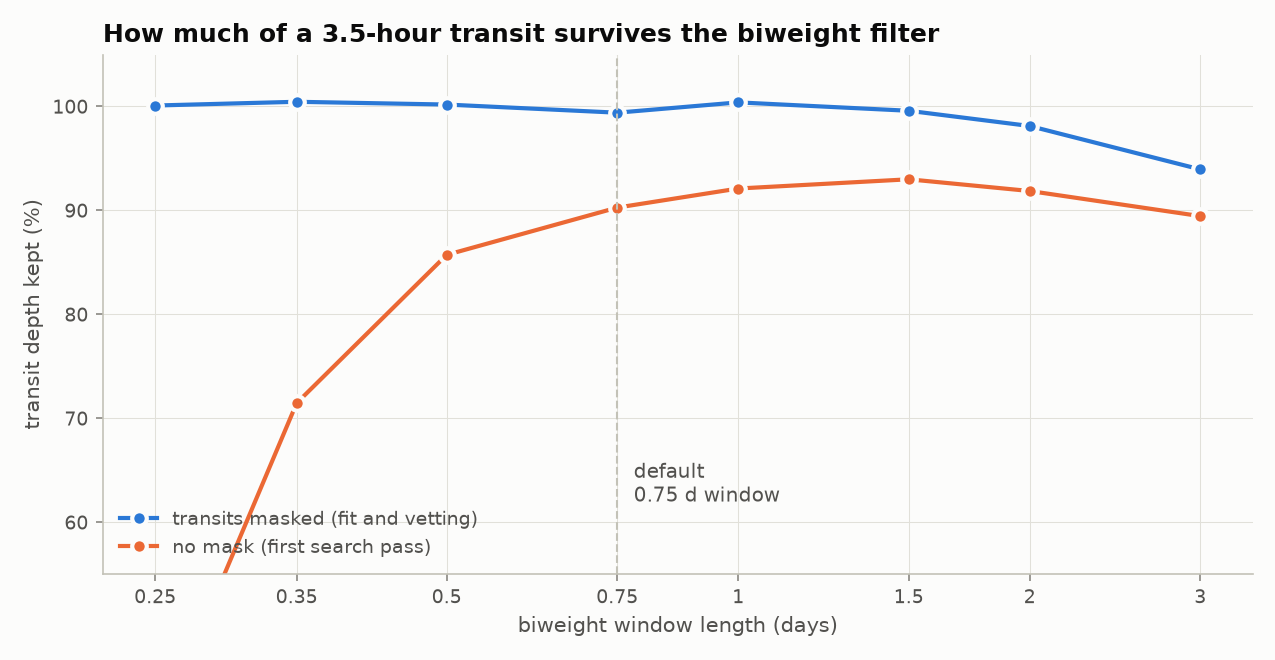
detrend(). A 2.5 R⊕, 3.5-hour transit in a spotted Sun-like star. With the transits masked (blue), the depth is preserved to within about 1 % for windows from 0.25 to 1.5 days. Unmasked (orange), short windows eat the transit: at 0.35 days only about 70 % survives. The 0.75-day default keeps about 90 % in the first pass, and the masked re-detrend recovers the rest before fitting.Why not just use a longer window?
A longer window follows fast starspot changes less closely and leaves more variability
behind, which raises the noise floor and creates false alarms at the rotation period. The
window is a trade-off, which is why it is a command-line option (--window).
Masking again after every detection
Each time the search finds a planet, the raw light curve is detrended again with all transits found so far masked, before the search looks for the next one. An unmasked trend dips slightly under every transit and leaves small positive “shoulders” either side of it. Those shoulders repeat at the planet’s period, and folded at a subharmonic P/n they can stack into a spurious signal. Re-detrending with a mask removes them.